
By Nicholas P. Timms (Tymmesa Lab) Feb 4, 2026
The following report is designed as a “Biocomputational Engine.” It is not a wall of text. It is a series of discrete “Scenes”—mental events designed to update your understanding of your physical universe, step by step. Take a breath. Let’s begin.
SCENE I: The Crystal Silence
Setting the Stage (The Status Quo)
Close your eyes and visualize a perfect diamond. Cold. Transparent. Eternal.
In the classical view of physics, this crystal is a sanctuary of order. When you tap it, energy moves through it like a ripple across a still pond. For over a century, physicists have described these ripples as phonons: collective, wave-like vibrations that carry heat and sound.
In this perfect world, the rules are simple. The vibrations follow a linear path, predictable and smooth, until they hit the edge of the atomic lattice. This behavior was mapped out by the famous Debye model back in 1912. It explains why a diamond feels cold to the touch and why bells ring true. It describes a universe of “Crystalline” order, where energy travels long distances without interruption.
This is the Reference State of your mental model: A world where structure dictates a perfect, predictable hum.
SCENE II: The Ghost in the Glass
The Anomaly (The Conflict)
But nature rarely tolerates perfection.
Now, imagine shattering that diamond and melting it down into glass. The order is gone. The atoms are now a jumbled, chaotic mess. If you tap this glass, the sound doesn’t travel smoothly anymore. It gets trapped. It stumbles.
For fifty years, condensed matter physicists have been haunted by a “ghost” in this disordered machine. When they measured the vibrations of glasses (and other messy solids), they found too much energy hanging around at low frequencies. They called this the Boson Peak.
It became a battleground. One school of thought argued that this peak was just a “smeared out” version of the crystal’s vibration, a ghost of the order that was lost. Another school argued it was something entirely new, a “local mode,” a specific vibration caused by the defects themselves.
This is the Prediction Error in your mental model. How can the same atoms produce two completely different vibrational realities? Why does the physics break down when we add disorder? The community was stuck in a “glassy” state of confusion, unable to reconcile the two views.
SCENE III: The Tuning Fork
The Resolution (The Discovery)
Enter the new unified framework by Ding et al. (2025).
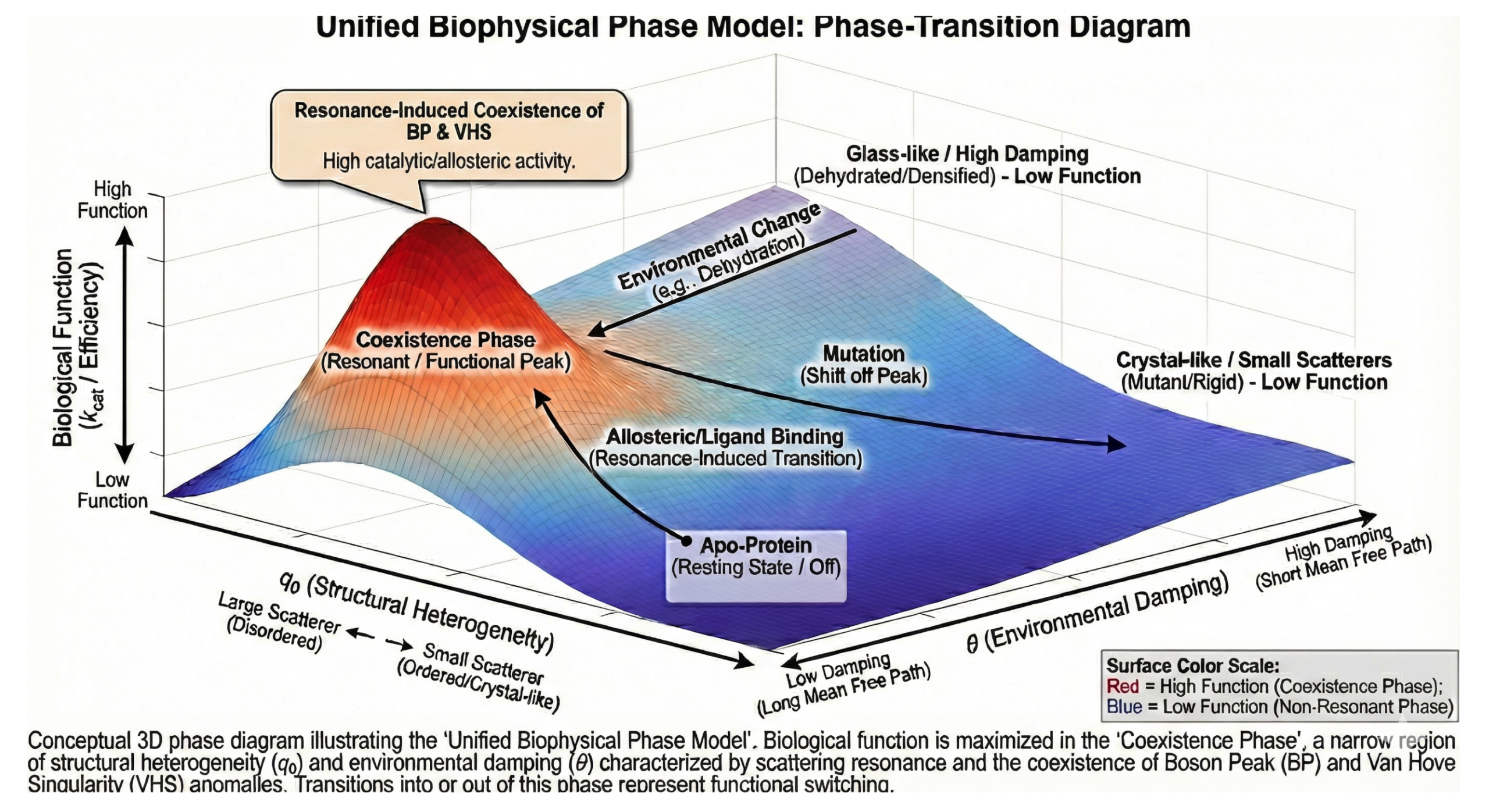
Think of their discovery not as a new equation, but as a Phase Diagram, a map. They realized that the “Crystal” and the “Glass” are not separate worlds. They are just different coordinates on the same map.
The researchers discovered that the vibration of any solid is controlled by two invisible knobs:
-
The Scatterer: How big are the “clumps” of disorder in the material?
-
The Damping: How thick is the “fog” that the sound waves have to travel through?
Here is the State Transition for your brain: When the fog is thick (high damping), the distinct crystal vibrations get smeared out, creating the Boson Peak. The “Ghost” theory was right.
However, when the fog clears and the scatterers are just the right size, something magical happens. The local defects start to resonate with the global sound waves. It’s like a tuning fork vibrating in perfect harmony with a piano string.
In this rare “Coexistence Phase,” the material exhibits both the broad hum of the glass and the sharp pitch of the crystal simultaneously. The unified model proves that disorder isn’t just noise, it is a tunable instrument.
SCENE IV: The Breathing Sculpture
The Application (The Transcendence)
Now, let’s leave the cold lab and step into the warm, wet chaos of your own body.
Your body is built of proteins. For decades, biology treated proteins like rigid keys fitting into locks. But the new unified model suggests a startling truth: Proteins are functionally disordered solids.
Imagine an enzyme not as a static sculpture, but as a breathing, vibrating gelatin. It has “Scatterers” (its active sites) and a “Medium” (its hydration shell, the water hugging its surface).
The authors propose a radical new theory of life:
-
Allostery as Resonance: When a signal molecule binds to a protein, it doesn’t just change the shape; it “tunes” the protein’s vibration. It pushes the protein into that magical “Coexistence Phase,” allowing a signal to travel instantly across the structure via resonance.
-
Catalysis as a Vise: When an enzyme grabs a target, it creates a “scattering resonance” so powerful that it creates a localized mechanical instability. The sound waves actually focus their energy to crush the target molecule, acting as a “Vibrational Vise” to drive chemical reactions.
SCENE V: The Master Curve
The Future (The Call to Action)
This is the final update to your mental simulation.
The researchers took data from 143 different materials: metallic glasses, high-entropy alloys, crystals, and polymers. When they plotted the vibrational heat capacity of all these diverse substances against their model, everything collapsed onto a single, perfect line.
They call it the Master Curve.
It means the protein in your cells, the glass in your window, and the silicon in your computer are all dancing to the same physical laws. They are just tuned to different frequencies.
The takeaway: You are not a static observer. You are a resonant manifold. The physics of the “anomalous” is actually the physics of life. The next time you feel a pulse, remember, it’s just a phonon finding its path.
*** This article synthesizes findings from “A Unified Mechanistic Framework for Non-Debye Anomalies in Solids. Click here for Open-Access to the full research paper.
Leave a Reply